New Tax Regime vs Old Tax Regime: Why Investment Planning Matters More Than Ever
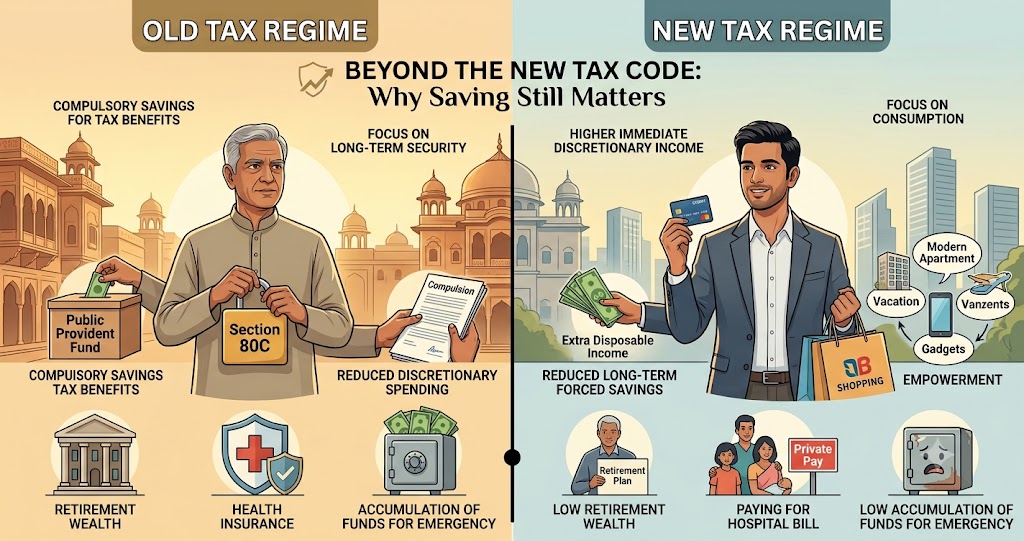
New Tax Regime vs Old Tax Regime: Why Investment Planning
Matters More Than Ever
For generations, Indian households had an unintentional
superpower: forced financial discipline. Every tax season, millions of us would
rush to complete our Section 80C declarations. We bought pure insurance plans,
locked money in Public Provident Funds, and started ELSS mutual fund SIPs. We
did it to lower our tax bill, but behind the scenes, that habit was quietly
building our long-term safety net.
With the New Tax Regime, the fiscal landscape has changed.
By removing most deductions in exchange for lower tax brackets, the state
transitioned from guiding your choices to handing you direct control over your
cash flow. Having extra disposable income feels empowering, but from a
long-term planning perspective, removing those tax triggers strips away our
primary incentive for disciplined wealth creation.
Are We Moving from Saving to Spending? Historically,
Indian families relied on a "save first, spend later" philosophy.
However, national economic trends highlight a noticeable structural shift.
While overall household savings remain present, net financial savings—the
actual money families keep in bank deposits, shares, and bonds after accounting
for debt—have seen a marked decline. Meanwhile, household financial liabilities
driven by credit cards, personal loans, and consumer financing have grown
substantially.
In short: we are increasingly borrowing and spending today
at the expense of setting money aside for tomorrow. While higher consumer
spending fuels domestic economic growth on paper, it leaves individual families
exposed to unexpected financial disruptions without structured investment
planning.
The Reality: You Are Your Own Social Security In many
advanced economies, a consumption-led lifestyle is backed by public safety
nets—state-funded healthcare, subsidized education, and public pensions. In
India, fiscal constraints mean the middle class gets minimal public coverage.
When life events occur—a major medical diagnosis, a sudden
loss of income, or simply reaching retirement—the government will not fund your
expenses. The money you decide not to save today simply because "it no
longer offers a tax exemption" is the exact capital you will need when
hard times hit.
Reframing Personal Finance & Investment Planning
Tax deductions were always a secondary benefit; the primary goal of any asset
allocation or insurance policy is capital protection and risk management.
Effective investment planning involves rebuilding your financial
framework without relying on tax rules:
- Comprehensive
Health Insurance & Risk Protection: Treat term life insurance and
robust health insurance covers as non-negotiable living
expenses—just like your electricity or utility bills. Health insurance
is essential for transferring catastrophic medical risks away from your
hard-earned savings, preserving capital during emergencies.
- Goal-Linked
Wealth Creation: Equity Mutual Funds offer liquidity and
inflation-beating long-term growth. Instead of investing just for
mandatory lock-in periods, set up automated SIPs tied directly to concrete
milestones like retirement or children's higher education.
- Liquid
Emergency Reserves: Keep several months' worth of essential household
run-rate expenses in high-liquidity instruments to absorb unforeseen life
disruptions.
Aligning Personal Finances with Virtual CFO Oversight
Just as businesses rely on a Virtual CFO to manage capital allocation,
monitor cash outflows, and ensure long-term solvency, individual households
need the same level of strategic cash flow management.
Moving to the New Tax Regime shouldn't mark the end of your
savings habit. It simply requires moving from saving out of tax compulsion to
saving out of personal conviction.
Navigating your financial strategy without old tax shortcuts
requires a clear, objective look at your cash flows and future goals. Whether
through personal investment planning, adequate health insurance
coverage, or business-level Virtual CFO advisory, analyzing your
expenditures, investments, mutual funds, and risk covers ensures your financial
health remains aligned with your long-term life vision.