FEMA 2026: New EDF Requirement for Service Exports from 1 October 2026
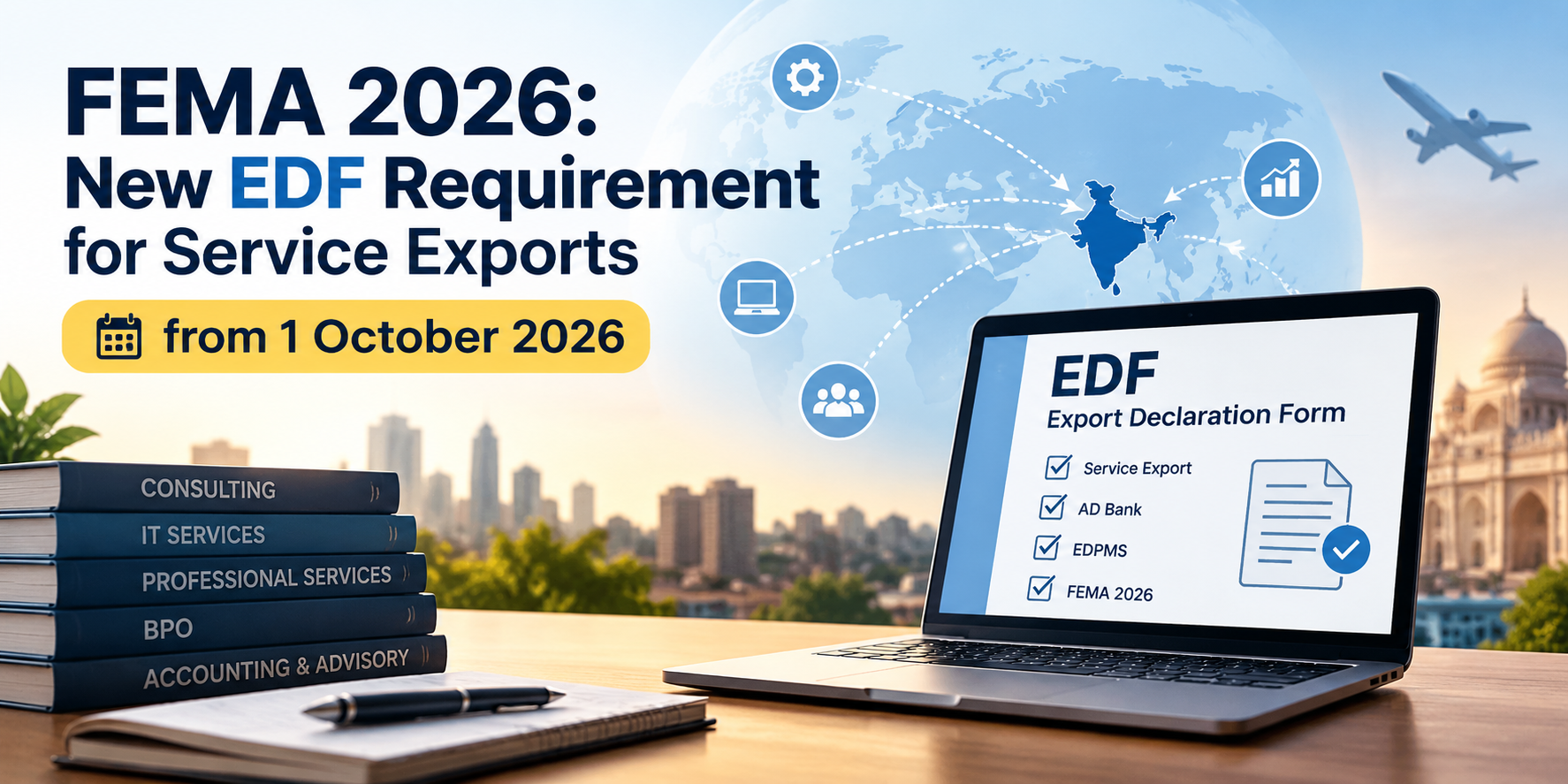
From 1 October 2026, businesses exporting services from India have an important new FEMA compliance requirement — the Export Declaration Form (EDF).
The change is relevant not only to software companies, but also to businesses providing consulting, accounting, BPO, IT-enabled and other professional services to customers outside India.
For businesses regularly undertaking international transactions, EDF will now become part of the routine export compliance process.
What is EDF?
EDF stands for Export Declaration Form.
It is a declaration of the value of services exported by an Indian business to an overseas customer.
Under the Foreign Exchange Management (Export and Import of Goods and Services) Regulations, 2026, service exports have been brought within the common export declaration framework.
In simple terms:
If an Indian business exports services to a foreign customer, the transaction needs to be reported through the prescribed EDF mechanism.
Who needs to file EDF?
The requirement can apply to businesses providing services to overseas customers, including:
Accounting and bookkeeping
Consultancy
BPO and back-office services
IT-enabled services
Engineering and technical services
Management services
Professional services
Customer support
Other services provided to customers outside India
Therefore, EDF compliance is not limited to large exporters or software companies.
When does EDF need to be submitted?
The general rule is that the EDF should be submitted within 30 days from the end of the month in which the service invoice is raised.
Example
A Jaipur-based consulting company raises an invoice on a US customer on 15 October 2026.
The invoice falls in October 2026.
Therefore:
Invoice month: October 2026
Month-end: 31 October 2026
EDF deadline: 30 November 2026
Businesses should therefore include EDF tracking in their monthly invoicing and finance process.
Can one EDF cover multiple invoices?
Yes.
The new framework allows a single EDF to cover service exports made to one or more overseas recipients during a month.
Example
During October 2026, an Indian company raises:
5 invoices to US customers
3 invoices to UK customers
2 invoices to UAE customers
The monthly service exports can be covered through the prescribed EDF mechanism rather than treating every invoice as a completely separate FEMA filing exercise.
This is particularly useful for businesses with a large number of recurring service invoices.
Where is the EDF filed?
This is perhaps the most important practical question.
For a normal DTA service exporter, the specified authority is the Authorised Dealer (AD) Bank.
Therefore, service exporters should not look for an EDF filing facility on ICEGATE, as is done for physical goods exports.
The broad process is:
Service Invoice ? EDF ? AD Bank ? EDPMS ? Export Proceeds ? Reconciliation
The exact electronic submission process may depend on the procedure adopted by the particular AD Bank.
What about software and SEZ exporters?
The basic EDF framework applies to service exports, but the specified authority can differ depending on the nature and location of the export.
For example, software exports and exports by SEZ units have specific provisions involving STPI and the Development Commissioner/SEZ system.
For physical goods exported through an EDI port, the Shipping Bill is treated as the EDF declaration.
Therefore, businesses should not assume that the filing process for goods, DTA services and SEZ services is identical.
What should businesses do now?
Businesses providing services to overseas customers should consider maintaining a simple FEMA Export Register containing:
| Particular | Details |
|---|---|
| Invoice date | Date |
| Customer | Overseas customer |
| Country | Customer's country |
| Nature of service | Description |
| SAC | Applicable SAC |
| Invoice value | Foreign currency |
| EDF date | Date submitted |
| Payment date | Actual receipt |
| EDPMS status | Open/Closed |
| BRC/e-BRC | Where applicable |
The objective should be simple:
Every export invoice should be traceable from invoice ? EDF ? bank receipt ? EDPMS ? closure.
This will also make bank reconciliation and year-end audit considerably easier.
Why is this important?
Receiving the money from an overseas customer does not necessarily mean that the FEMA compliance is complete.
The export transaction also needs to be properly reported and reconciled through the banking system.
For businesses undertaking frequent international transactions, a missing or unmatched export declaration can result in unnecessary follow-ups from the AD Bank.
It is therefore better to make FEMA compliance part of the monthly accounting process rather than dealing with it only when a bank raises a query.
How can a Virtual CFO help?
For a growing business, accounting, foreign currency receipts, FEMA compliance, EDPMS and taxation often get handled by different people.
A Virtual CFO can bring these activities together into one monthly process:
Invoicing ? FEMA reporting ? Bank reconciliation ? EDPMS monitoring ? BRC/e-BRC ? Management reporting
This provides management with a clear view of both the financial position and FEMA compliance status.
For businesses undertaking regular international transactions, working with a CA experienced in FEMA can also help identify reporting gaps and ensure that export transactions are properly documented.
Conclusion
The introduction of EDF for service exports is an important change under FEMA 2026 from 1 October 2026.
The practical takeaway for service exporters is straightforward:
Raise invoice ? Prepare EDF ? Submit through the applicable authority/AD Bank ? Track EDPMS ? Reconcile export proceeds.
Businesses should update their internal processes so that FEMA compliance becomes part of the normal monthly finance cycle.
Whether you are a service provider, exporter, SEZ/STPI unit or a company regularly undertaking international transactions, putting a proper FEMA process in place can prevent avoidable bank queries and reconciliation issues.
For businesses looking for support with FEMA compliance, international transactions, taxation or Virtual CFO services, professional guidance can help integrate these requirements into the regular finance function.